
Yesterday Mum and I did a long road trip, visiting Cyprus’ third largest city of Larnaka, then crossing the border in to the Turkish Reublic of Northern Cyprus.
We set off soon after breakfast for Larnaka, stopping there to visit the Larnaka Salt Lake. The lake already drying up, a layer of salt is left on the lake bed which resembles snow. It felt strange walking across this.
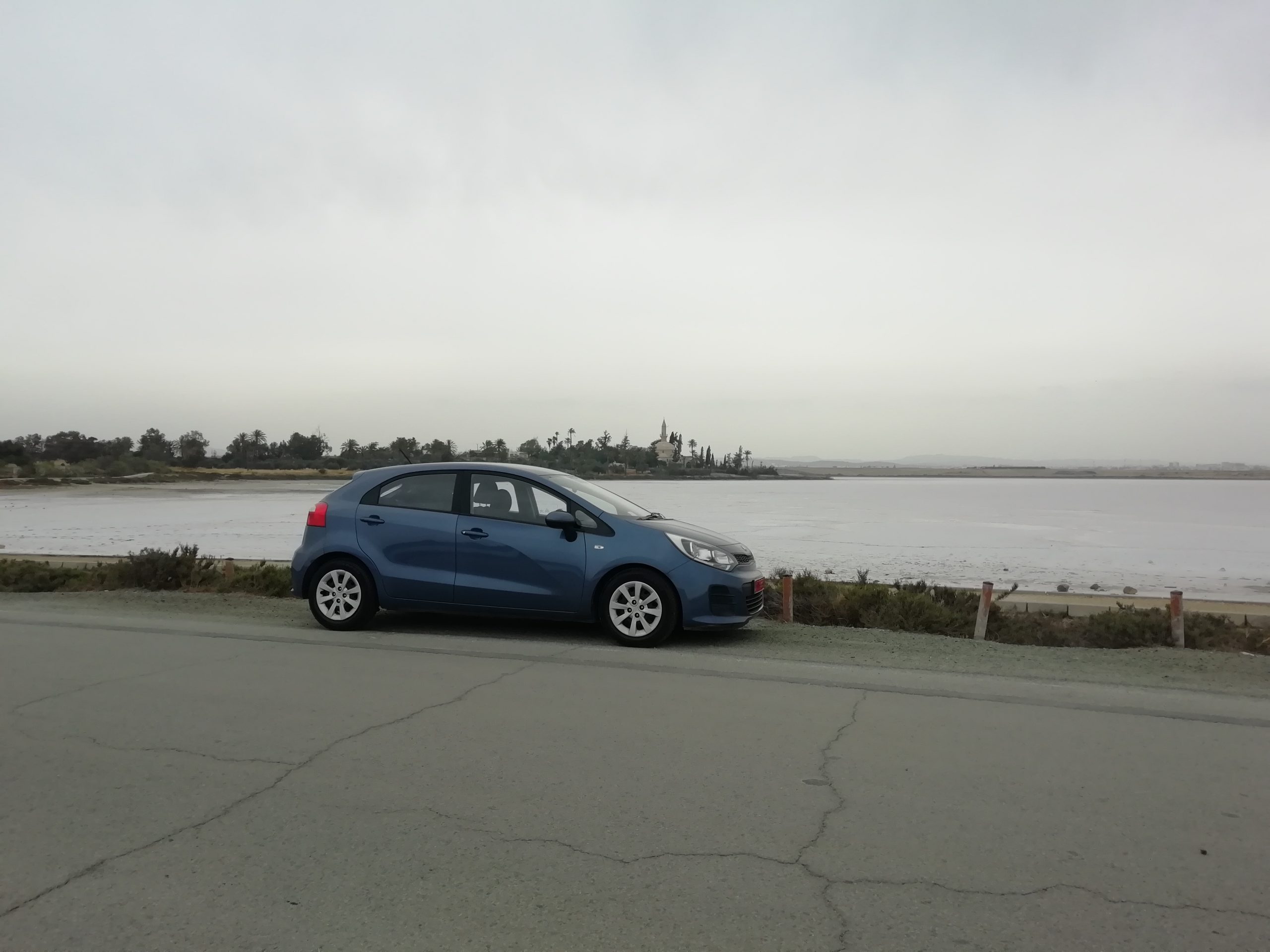
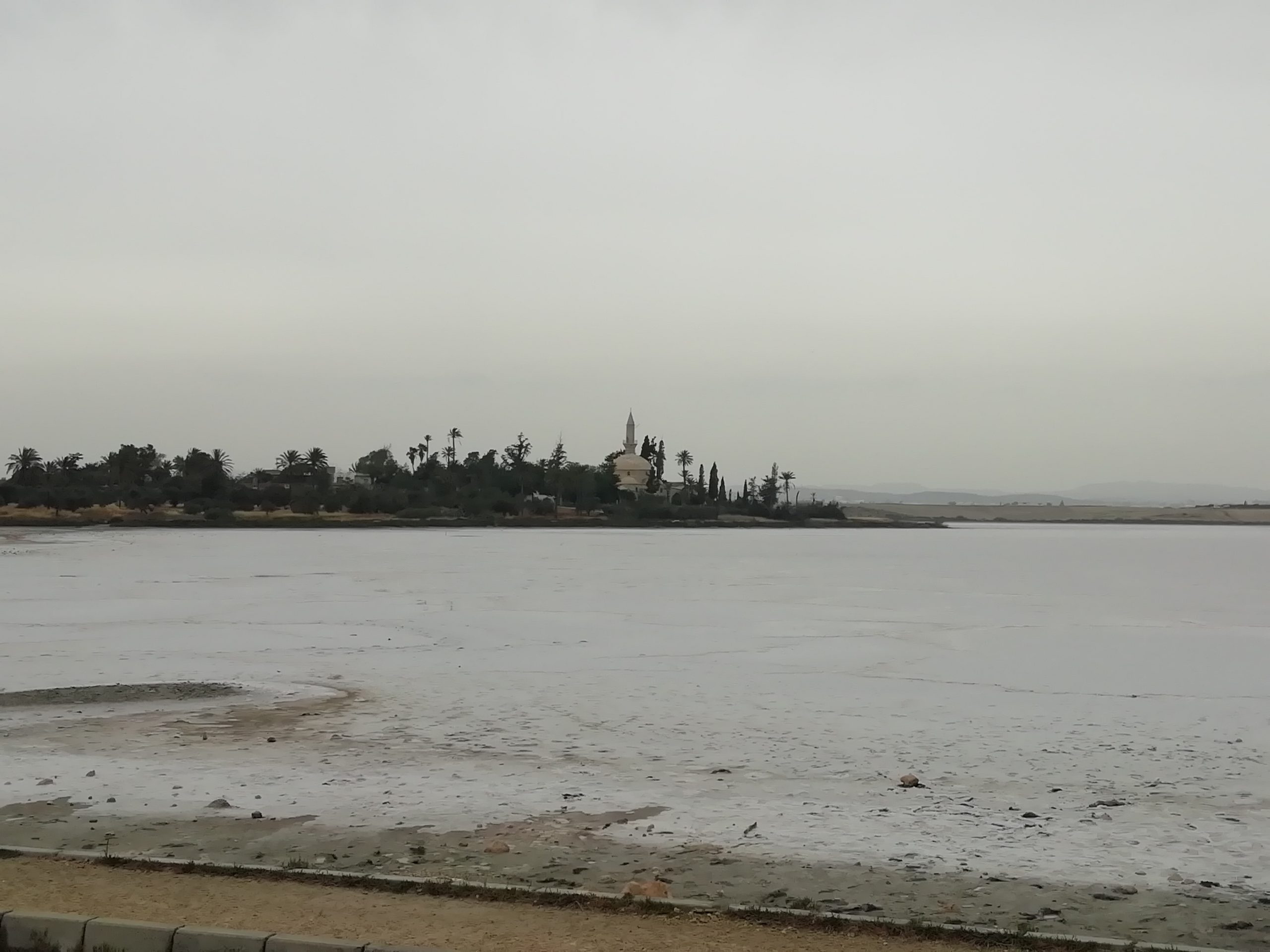


We then headed for the border to enter Northern Cyprus (known in Greek as “the Occupied Territory” – the Republic of Cyprus (and the rest of the world, with the exception of Turkey) not recognising TRNC’s sovereignty.
Going South to North, the borders are not signed at all. I opted to cross the border at Πύλα – Pyla. One of only four villages within the demilitarized zone (the UN buffer zone, or the “Green Line”), it is also the only village on the island where, after the Turkish invasion of 1974, the original inhabitants, Greek Cypriots and Turkish Cypriots, continue to coexist to this day. It is administered as though it were part of the Republic of Cyprus, but policed by the UN instead of civilian police.
This situation means that, whereas at other border crossings you pass through the Greek Cypriot passport control, cross the UN buffer zone (which could be a couple of hundred metres or a couple of kilometers, depending on which border crossing you use), then pass through Turkish Cypriot passport control; However at Pyla, there is no border control prior to entering the UN buffer zone; Instead, shortly after leaving the village of Pyla you arrive at the border of the Turkish Republic of Northern Cyprus.
Occupying 36% of the island, Northern Cyprus as an independent soverign nation is recognised only by Turkey; The Republic of Cyprus, the UN, and the EU, recognise the Republic of Cyprus as having soverignty over the whole island and consider the TRNC as illegal occupation of EU territory.
On crossing the border our passports were checked – and we bought car insurance for North of the border (€20 for the day); This was a little confusing as we needed the insurance before the passport check but the insurance booth was after the passport control booth.
Also, in the past I’ve been able to get the insurance pre-paid and arranged by the car hire firm (meaning I already had the insurance certificate on crossing the border and didn’t have to buy it at the border); This time round that wasn’t the case as we were using a car hire firm which does not officially endorse driving over to the North (the case with the majority of car hire firms in Cyprus; Travelling across the border in a rental car, regardless of which firm you are with, is done entirely at your own risk – in the event of an accident or break down, it is your responsibility to get the car back across the border).
Insurance and passports checked, we were on our way. It took about half an hour from there to get to our destination; Famagusta – known in Turkish as Gazimağusa or in Greek as Αμμόχωστος (Ammochostos). Once a very important trading hub, Famagusta today has the old town, surrounded by the ancient venetian walls; many churches (now used as mosques) which are very impressive. As part of Northern Cyprus, it does feel different to the Greek part of Cyprus but has a pleasant relaxed atmosphere. There are plenty of bars, restaurants, cafés and tourists shops to visit. We stopped for Lunch at one; Mum had a burger and I had meatballs.


We then drove down towards the coastal district of Βαρώσια – Varosha, known in Turkish as Maraş. The last time I was here, it was very much a case of “no photography”; this enforced by Turkish Cypriot soldiers; Since 2020 the district has been opened up – to walk about at least – and there’s even a taverna on the beach – at the site where watch towers, Turkish flags and TRNC soldiers once stood to make sure no one was taking photos of the abandoned city.
Entry in to the abandoned quarter of Varosha is free – but you can also pay a small fee to rent a bike, scooter, or have a tour of the area on a golf buggy. There are a couple of cafés and kiosks, toilets and showers availabe, and parts of the beach where swimming and sunbathing is permitted. A Dark Tourism website has a detailed account of one person’s visit to Varosha.
We had limited time and it would be interesting to visit properly as we only really scratched the surface of what there is to see in Varosha, visiting an open section of beach immediately next to Palm Beach; the taverna standing where as recently as 2019, the Turkish military watch towers once stood. We also walked up part of what was once ΔΗΜΟΚΡΑΤΙΑΣ – Democracy Street, with the old grammar school now completely derelict but with massive Turkish and Northern Cyprus flags covering the main entrance of the building.
As it would take us a couple of hours to get back to Pissouri we got back in the car and headed for the border – this time driving through the SBA (Soverign Base Area), meaning after exiting the Turkish Republic of Northern Cyprus our passports were checked by the British – SBA Customs and Immigration. Our entire route back to the motorway was on road which is in fact United Kingdom territory.


We stopped in Larnaka, near the Agios Lazaros church in the city centre, opposite the hotel I’ve stayed at before (Opera), to get a drink from a bakery. Then we got back in the car and headed back to Pissouri, arriving back at 19:20.

In the evening we walked down to the village to find somewhere to eat. We decided to eat at the Artemis restaurant which was quiet, but the food was good – and I liked it because the waitress spoke to us in Greek (in Cyprus they like to speak English!)
Today, much of the cloud has cleared and the Sun is out again (hooray); Later this afternoon Mum and I are going horse riding – looking forward to that.
FH.
